

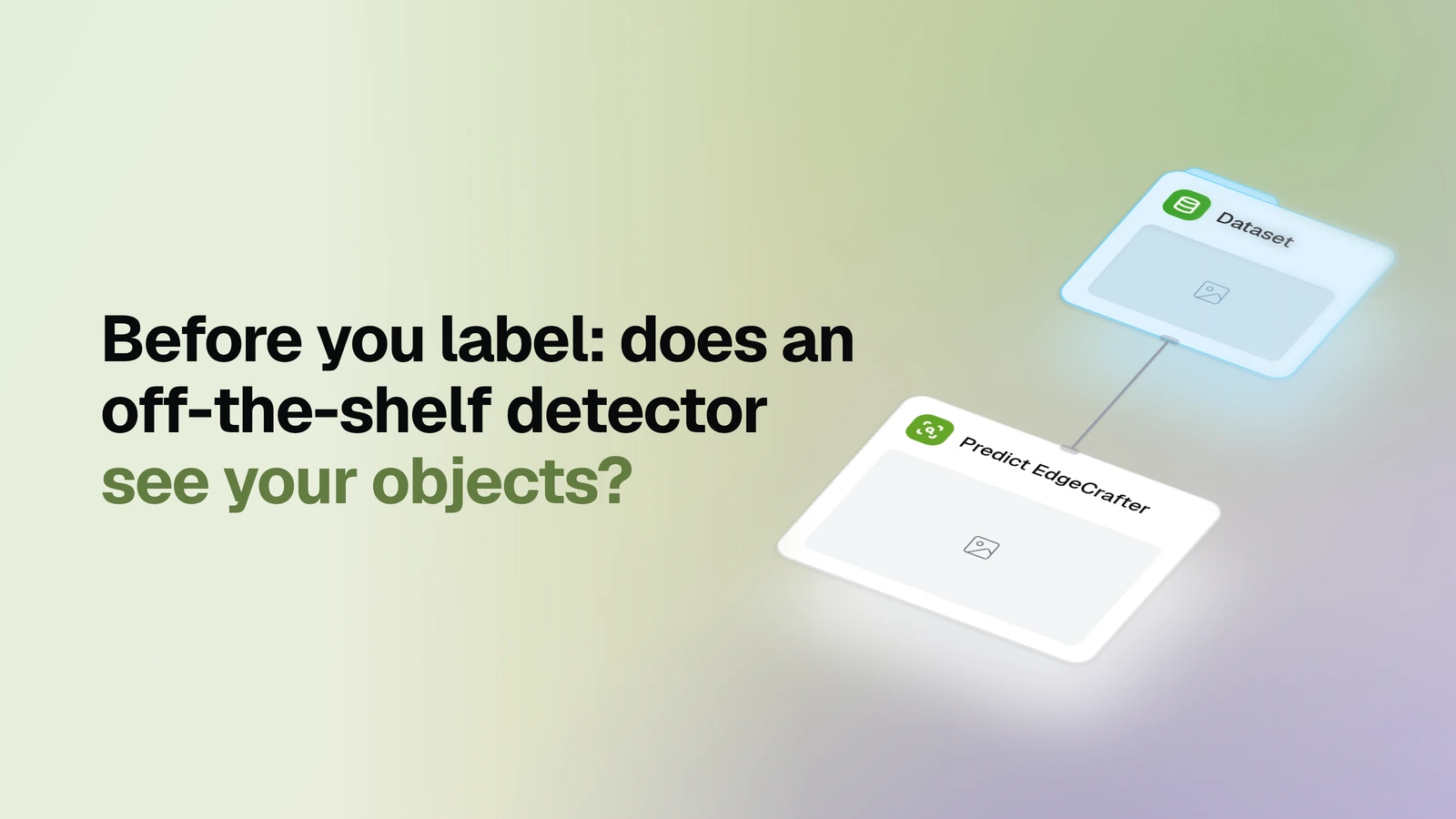
See what a ready-made detector finds on your own images, before you spend anything on labels or training.
Overview
- Task: Object detection
- Input: An unlabeled pool of images
- Pipeline: pick a dataset → run a pretrained detector
- Output: The same images back with predicted boxes, each carrying a class label and a confidence score
When you need it
Ready-made detectors are trained on public benchmarks, so the cheapest question before paying for labeling or a training run is whether one even reacts to your images at all — and in what vocabulary it answers. If you have a folder of raw images and no labels yet, this is the run that comes first: it tells you whether the pool is worth annotating, and whether a ready-made detector is a plausible starting point for your domain.
What you need
An image dataset already in OvalBee — no labels, no held-out set, no training data. If your images aren't in OvalBee yet, bring them in with one of the import templates first.
How it works
| Step | What happens |
|---|---|
| Dataset | You pick the pool of images to run on |
| Predict | A pretrained detector runs over every image and returns it with predicted boxes |
The detector, its confidence threshold and its batch size come already set — there is nothing to configure before the first run.
What a prediction run gives you
The class and confidence on every box are enough to judge by eye whether the detector finds the right things on your material and where it looks shaky, without waiting on a labeled test set. Point the same template at another dataset or swap in a different pretrained model, and OvalBee predicts again on its own. What comes back is the detector's own read of your material, not a score against ground truth — there is none in the run.
Related templates
- Tracking by detection — the same zero-label screening idea, run on video instead of images
- Detector evaluation — the scored version of this run, once labels exist
- Fine-tuned vs COCO (images) — if the off-the-shelf vocabulary doesn't fit, proves whether fine-tuning on your own images is worth it